Power supply, on-board power systems and charging technology

Providing electrical energy as required
An electrical system needs more than a suitable energy source. The energy must reach the consumers with the required voltage, power and supply quality. The system must operate stably during switch-on and dynamic load changes and respond in a defined way to specified fault cases. Where present, the charging function, energy storage and auxiliary consumers must be aligned with the energy architecture.
Silver Atena develops solutions for electrical power supply, on-board power systems and charging technology. We consider energy sources, voltage levels, converters, consumers and protection functions as a single system. This results in concepts for the distribution, conversion, monitoring and provision of electrical energy.
Challenges in on-board power systems and power supply
When several consumers share the same supply, a change in load can also affect other functions. High power requirements and rapid load steps must be considered at system level, as must disturbances and fault states.
Different voltage levels increase the demands on integration. Energy must be transferred between high-voltage and low-voltage systems without exceeding the defined limits of source, converter or consumer. Charging adds the characteristics of the external supply and the requirements of the energy storage system.
Monitoring, diagnostic and protection functions must be taken into account in the energy architecture from the outset. Short circuits, overcurrent, overvoltage or undervoltage, insulation faults and thermal overload can be safety-relevant. The measures required depend on the product, application and safety concept. The energy architecture influences the available power, electromagnetic compatibility (EMC), safety and the behaviour of the overall system.


Services for power supply, on-board power systems and charging technology
We develop concepts for high-voltage and low-voltage on-board power systems, couple voltage levels and integrate electrical consumers. This includes charging functions, protection and diagnostic concepts and energy management.
Energy and on-board power system architecture
The design starts with the energy sources and consumers. Aspects considered include power demand, simultaneous loads and their dynamics, the voltage levels to be connected and behaviour in the event of disturbances. From this, we derive requirements for supply, distribution, conversion and monitoring and define interfaces, energy paths, operating modes and, where applicable, consumer priorities.
Coupling high-voltage and low-voltage systems
DC/DC converters connect DC voltage levels and are designed to suit the source, load, operating range, efficiency and cooling. Among other things, Silver Atena develops high-voltage converters for integrating fuel cell systems into vehicle electrical systems and aligns the converter function with the higher-level energy architecture. Energy conversion builds on our expertise in power electronics.
DC charging technology and voltage adaptation
Charging technology must suit the external supply and the energy storage system. Key factors are voltage and power ranges as well as control, communication and monitoring of the energy flow. Silver Atena's DC Boost Charger, for example, raises a lower DC charging voltage to the level required for an 800 V vehicle system and is integrated into the on-board power system and system architecture.
Supplying auxiliary consumers
In addition to the main drive, auxiliary functions also require electrical energy. With changing loads, control behaviour, effects on the on-board power system and permissible operating limits are particularly important. Among other things, Silver Atena develops electric power take-off systems (ePTO) that convert energy from the vehicle electrical system and supply it as required to auxiliary units and vehicle bodies.
Battery management systems
A battery management system captures relevant battery parameters, assesses the battery state and supports operation within the defined voltage, current and temperature limits. Depending on the system, this also includes diagnostics, balancing and contactor control. Silver Atena develops BMS solutions for different voltage levels.
Bidirectional energy flows
In bidirectional systems, energy can be transferred in both directions. Components and control must be aligned with the intended operating states. The permissible direction and power as well as switching between operating modes depend on the specific application.
Protection, disconnection, pre-charging and diagnostics
An energy architecture requires defined behaviour at switch-on and in fault states. Protection, disconnection and pre-charging are therefore considered together with the system design. Diagnostics and monitoring capture relevant electrical states and trigger the intended responses. Silver Atena aligns these functions with hardware, control, software and functional safety.
Development process for electrical supply systems
- Requirements and load profiles: Operating states, load profiles, interfaces, switch-on processes and specified fault cases are described. At the same time, it is defined which analyses, simulations and tests will be used to demonstrate compliance with the requirements.
- Architecture and design: Energy paths, voltage levels, converters, charging electronics, monitoring and protection are aligned with one another. Depending on the system, this also includes the coordination of fuses, contactors and electronic protection functions.
- Control and integration: Control and embedded software implement operating strategies. Components and consumers are integrated step by step.
- Verification and qualification: Verification tests check operating states, protection functions, diagnostics, EMC and thermal behaviour. Additional qualification tests result from the product, application and agreed standards.
The results of integration and testing feed back into the design. If, for example, impermissible voltage fluctuations or excessive thermal load occur, the cause is investigated in the interaction of source, converter, consumer and operating strategy.
Load profiles and standards for on-board power systems and power supply
Load profiles show the continuous and peak power consumers require, how quickly the load changes and what energy demand arises over a defined period. This results in requirements for the energy source, storage, converters and control. Investigations accompanying development also consider EMC, losses and thermal load.
For automotive projects, depending on the product and voltage level, ISO 26262, ISO/SAE 21434, LV 123, LV 148 or the ISO 21498 series may be relevant.
In the aerospace and defence sector, requirements from RTCA DO-160 or MIL-STD-704 may also apply. The applicable issues, test profiles and evidence are defined for the specific project.
Power supply and on-board power systems in automotive, aerospace and defence
Automotive
In vehicles, different voltage levels and consumers must work together. The charging function, battery, drive and auxiliary units each place their own requirements on the supply. For this purpose, Silver Atena develops DC/DC converters, DC Boost Chargers, electric power take-off systems and battery management systems for low-voltage and high-voltage architectures.
Aerospace
In aviation, the electrical supply must suit the connected functions and the intended operating conditions. Mass, available power, supply quality, redundancy and behaviour in the event of failures influence the architecture. The requirements of avionics, actuators and other consumers determine how energy is provided, monitored and handled in the event of a fault.
Defence
Mobile defence systems can have highly variable, pulsed or continuously high electrical loads. The energy architecture must be designed for these loads and the specified operating conditions. Protection, diagnostics and defined behaviour in the event of supply fluctuations are among the key development tasks.
Benefits of a coordinated energy architecture
Considering sources, converters and consumers together makes integration issues visible at an early stage. Load profiles, voltage ranges and fault states are treated as requirements for the overall system. This allows components to be aligned with one another before a complete set-up is available.
This creates a traceable basis for the project. It shows which power is available under which conditions, how consumers influence one another and how relevant faults are detected and handled. Efficiency, losses and supply behaviour must nevertheless be demonstrated on the specific system and under real operating conditions.

Power supply across engineering disciplines
Power supply, on-board power systems and charging technology are linked to several development disciplines:
- System architecture and system integration define the structure, interfaces and energy paths.
- Power electronics and hardware development implement conversion, distribution and monitoring.
- Control development and embedded software control the intended operating states.
- EMC and thermal management support the electrical and thermal design.
- Functional safety and cyber security derive project-specific requirements and measures from the respective analyses.
- Testing and validation and environmental testing contribute to the required evidence together with analyses, reviews and simulations.
- Industrialisation and series production transfer prepare the product and manufacturing process for series production.
Why Silver Atena for power supply and on-board power systems?
Silver Atena combines the development of power electronic components with system architecture, control engineering, embedded software, verification and qualification. This allows energy flows and protection functions to be developed and tested in the context of the entire product.
Our solutions range from coupling different voltage levels and DC charging technology to supplying auxiliary units and battery monitoring. This project experience helps our teams to derive component requirements from the boundary conditions of the entire on-board power system and align them at the interfaces.
Discuss the power supply for your system
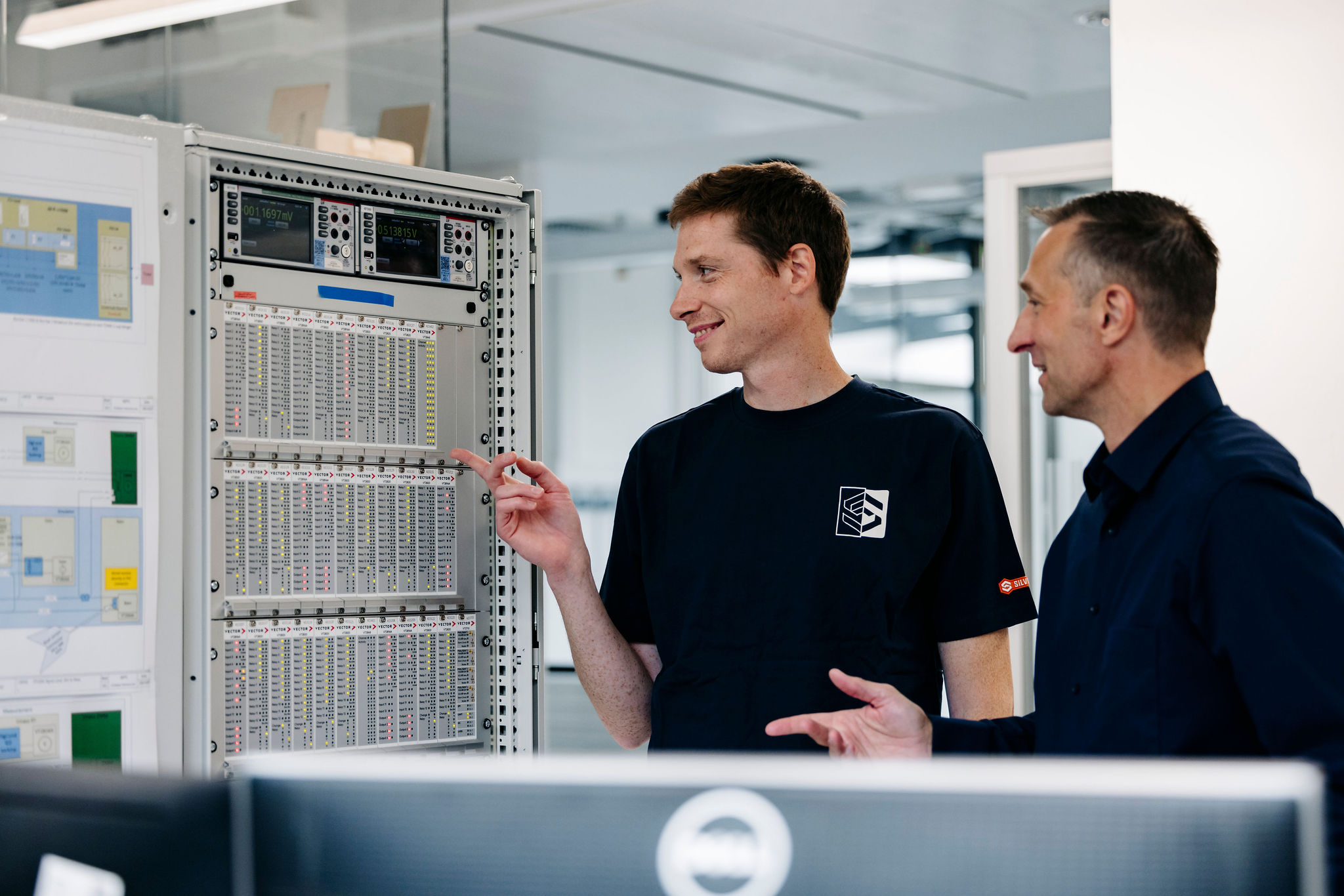
Are you planning an on-board power system, a charging function or the integration of electrical consumers? Discuss your energy architecture, operating conditions and interfaces with our team.